

There’s a familiar pattern that shows up again and again in early-stage gold stories.
First comes the land position in the right belt.
Then the early drill hits that suggest something bigger might be there.
Then the financing that gives the company enough runway to actually test the idea properly.
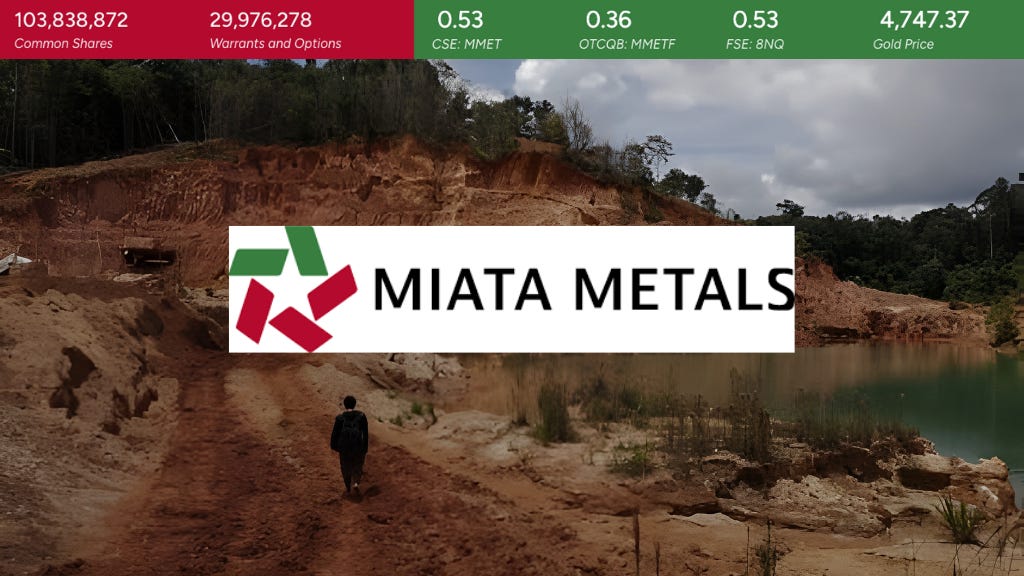
Miata Metals (CSE: MMET | OTCQX: MMETF) is now firmly in that third phase.
After a strong finish to 2025, Miata has quietly put itself in a position many junior explorers never reach: well-funded, actively drilling, and building momentum in a proven gold region that’s starting to attract attention.
The Quick Context
Miata is focused on gold exploration in Suriname, part of the Guiana Shield, one of the most prospective yet under-explored gold belts in the world. This is the same geological neighborhood that hosts multi-million-ounce deposits operated by majors and mid-tiers across northern South America.
Miata’s core focus right now is the Sela Creek Project, where the Company is actively drilling multiple priority targets, including Jons Trend. Instead of spreading itself thin, the company is concentrating capital and drilling where results are already starting to validate the geological model.
What Changed Recently
Miata Metals released final results from its 2025 drilling at the Sela Creek Gold Project in Suriname, delivering standout gold hits at the Jons Trend zone including 4.3 metres at 12.49 g/t gold and 22.7 metres at 2.23 g/t gold, helping confirm a large, continuous mineralized system. The strong results set the stage for a much larger 25,000-metre drill program in 2026, with additional upside coming from early success at the nearby Big Berg target.
In late 2025, Miata closed an $11.5 million public offering. That financing materially changed the company’s posture.
Instead of rationing drill meters, Miata is now doing the opposite.
The company added an additional drill rig and outlined plans for up to 25,000 meters of drilling at Sela Creek. That’s not a token program. It’s an aggressive push to define scale, continuity, and priority zones while gold prices remain supportive.
Early drill results are already giving the team confidence to lean in.
Why The Drill Results Matter
Miata has reported several encouraging intercepts from Sela Creek, including a standout interval of 35.6 m at 3.04 grams per tonne gold.
For retail investors, the takeaway isn’t just the grade, it’s the width and the consistency.
Longer intercepts at around one gram per tonne are often the building blocks of bulk-tonnage gold systems, especially when mineralization starts near surface. These are the types of results that justify follow-up drilling, step-outs, and more aggressive programs.
Miata has also outlined the Jons Trend, an emerging mineralized zone where near-surface gold appears to be expanding with additional drilling. That kind of structural definition is critical at this stage—it helps the company prioritize where the next meters go and where the system might open up.
Beyond Jons Trend
While Jon’s Trend has delivered the most eye-catching results to date, it sits within a much larger, highly prospective gold system at Sela Creek.
Multiple additional zones across the property are already advancing through discovery and follow-up drilling, with several returning strong near-surface gold intercepts, including Puma and Big Berg. These zones form part of a clustered, target-rich corridor that also includes areas such as Golden Hand and Stranger, supported by a broader pipeline of greenfield and conceptual targets across the Sela Creek land package.
Success at Jon’s Trend is increasingly viewed as validation of a broader system, shifting the story from a single discovery toward a district-scale opportunity where continued drilling has the potential to unlock value across multiple zones..
Capital Structure and Alignment
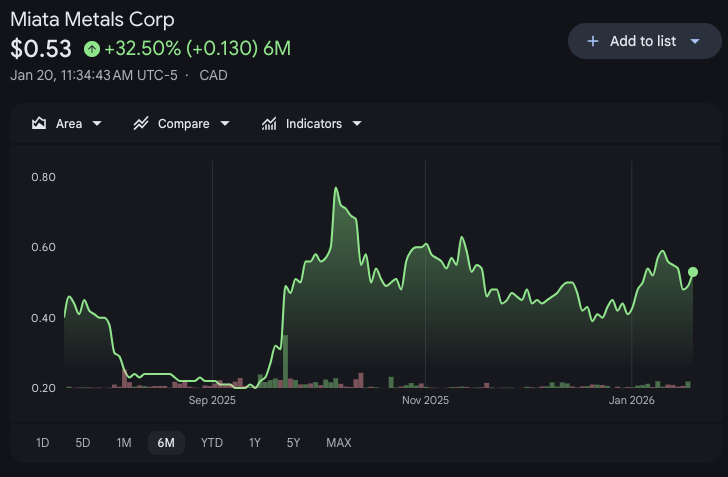
As of early January 2026, Miata trades around $0.50 per share with a market capitalization of roughly $47 million.
The company reported approximately $13 million in cash as of December 8, 2025, giving it meaningful exploration runway without immediate financing pressure.
Management and founders own about 22% of the company, a level of insider ownership that aligns leadership with shareholders as the drill program ramps up.
Why This Story Is Starting To Get Interesting
Miata is no longer just an early-stage idea. It’s a funded explorer executing an aggressive drill campaign in a gold belt that has already produced major discoveries.
Gold prices remain strong. Capital has returned to the sector. And the market is increasingly selective about which juniors it pays attention to.
Companies that are drilling, delivering results, and staying funded tend to stand out.
Miata now checks those boxes.
The Bottom Line
Miata Metals is still a speculative exploration story. Drill results will ultimately decide how this plays out.
But the setup has improved materially over the past few months: a strengthened balance sheet, expanded drilling, encouraging early results, and a focused strategy in a proven gold jurisdiction.
For investors who follow early-stage gold exploration, Miata is no longer one to ignore, it’s one to watch closely as drilling continues through 2026.
If you want a deeper breakdown of the geology, drill data, and upcoming catalysts, that’s where our full research report comes in.
Disclaimer:
This content was produced on behalf of Miata Metals Corp. and was disseminated as part of a paid investor awareness or marketing arrangement. This is not financial advice. Investing in exploration-stage companies involves significant risk, including the loss of capital. Readers should conduct their own due diligence and consult a licensed financial professional before making any investment decisions.