
Pilot data above the FDA bar. A 600,000-child national government deployment. A binary clearance decision inside 12 months — in a sector where ASX peers have re-rated by as much as 2,083%.
Cashu Research has initiated coverage on BlinkLab Limited (ASX:BB1) with a Speculative Buy rating and a 12-month price target of A$1.80 — 159% above the current A$0.695.

Over the past 18 months, the ASX has produced one of the most reliable setups in small-cap healthcare. AI diagnostic companies with strong clinical data and a credible regulatory pathway have cleared the FDA - and then re-rated violently. Artrya ran 2,083% off its low. 4D Medical climbed 952%. ResApp was taken out by Pfizer for A$180M.
BlinkLab (ASX:BB1) fits the same template…….with a few differences that make it stand out. Its reported pilot data are stronger relative to the FDA’s benchmark than either Artrya or 4D Medical were at the equivalent stage. It is already deploying across a national, government-funded screening program covering up to 600,000 children a year. And its core catalyst, an FDA clearance decision, is expected inside the next 12 months. The stock trades at just A$0.695.
The reason this matters now comes down to a system under strain. In the United States, the average wait from first developmental screening to a confirmed autism diagnosis exceeds two years. Fewer than 800 developmental-behavioural paediatricians serve an estimated 19 million children with developmental concerns, and a full evaluation can cost US$1,000–7,000.
Meanwhile autism prevalence has climbed from roughly 1 in 150 children in 2000 to about 1 in 31 eight-year-olds in 2022, around 7 million US children have an ADHD diagnosis, and Australia’s autism-related NDIS payments hit approximately A$10.3 billion in 2025 — more than double the A$4.2 billion of FY2020/21.
Demand is rising structurally; specialist capacity is not. The system needs faster, more scalable and more objective tools — and that is precisely the gap BlinkLab is built to fill.
Turning a smartphone into a diagnostic tool

BlinkLab (ASX:BB1) is an Australian digital-health company developing an AI platform that converts a standard smartphone into a clinician-prescribed neurometric assessment tool, without the need for dedicated specialist hardware.
During the assessment, the application presents visual and auditory stimuli while the front-facing camera and microphone capture reflexes, blink responses, head movement, gaze-related behaviours and vocalisations. Machine-learning models translate those signals into objective biomarkers, which are returned to the prescribing clinician through the cloud platform. The assessment takes approximately 30 minutes.
Founded by neuroscientists associated with Erasmus University Medical Center and Princeton University, BlinkLab has progressed from academic research into an active FDA program. Its lead product, Dx1, is an autism diagnostic aid; its second, Dx2, extends the same architecture to ADHD.
The commercial logic is straightforward. In a market where specialist capacity is scarce and wait lists are long, a hardware-light tool that runs on devices clinicians and families already own could be deployed across clinics, community settings and resource-constrained health systems far more readily than eye-tracking machines or specialist-led evaluations

Clinical data above the FDA benchmark
The reported pilot data are the central de-risking element of the investment case.
In a 485-child US pilot study, Dx1 reported 83.7% sensitivity and 84.7% specificity. Management has stated that the FDA pre-submission process confirmed a benchmark of greater than 65% on both measures.
The pilot therefore cleared the stated threshold with a meaningful buffer, reframing the pivotal study as a confirmation-at-scale exercise rather than an early proof-of-concept experiment. For context, the hardware-based eye-tracking comparator EarliTec reported 71% sensitivity and 81% specificity, while Cognoa’s Canvas Dx came in materially lower.
The pivotal study is already running — a double-blinded, multicentre validation program across 10 US autism research institutions (including Penn’s Perelman School of Medicine, Cincinnati Children’s, the Vanderbilt Kennedy Center and Seattle Children’s), executed with IQVIA-MCRA. Enrollment completion and FDA submission are targeted for Q4 2026, with a clearance decision expected in Q1 2027.
The pivotal study still needs to replicate pilot performance across a broader, multi-site population, and that remains the key regulatory risk. The starting point, however, is materially stronger than a typical early-stage medtech proof-of-concept.
A platform, not a single binary outcome
What distinguishes BlinkLab from many pre-clearance companies is that the US FDA decision is not the only source of value.
Morocco. BlinkLab has been selected for Morocco’s nationwide, government-funded autism screening program, run through the Foundation Mohammed V for Solidarity, with potential deployment across 3,000 centres and 600,000 children annually. That’s sovereign validation, a real-world data engine, and platform value that doesn’t depend on the US pathway.
Dx2 ADHD. The European clinical study with Mental Care Group is expected to report 300-patient results in Q2 2026. ADHD dramatically widens the addressable market beyond autism.
Europe. CE/MDR submissions for Dx1 and Dx2 are targeted for Q3 2026 — a regulatory track that runs independent of the FDA.
Each new study, geography and indication deepens BlinkLab’s labelled-data asset and strengthens the moat — anchored by a patent portfolio filed with Princeton covering remote neurobehavioral testing, with national filings across the US, Europe, Japan, Canada, Australia and Korea.
The FDA re-rating playbook
For investors, the most instructive context is not the autism market size but the trading history of ASX-listed AI diagnostic companies once they secured FDA clearance.
Artrya (ASX:AYA) went from A$0.24 in January 2025 to a peak of A$5.24 after 510(k) clearance — a 2,083% move from the pre-clearance price.
4D Medical (ASX:4DX) jumped 67% on clearance day in September 2025, then ran to an all-time high of A$4.84 by January 2026 — a 952% appreciation, helped by fast CMS reimbursement.
Echo IQ (ASX:EIQ) rose ~25% on clearance day in October 2024 and later hit a 52-week high of A$1.36.
And ResApp Health — whose smartphone respiratory diagnostic story rhymes closely with BlinkLab’s — was acquired by Pfizer for A$180M in 2022. (BlinkLab’s own chairman, Brian Leedman, co-founded ResApp.)
These are not cherry-picked outliers; they reflect a consistent pattern in which ASX investors re-rate AI diagnostic companies as regulatory risk converts into clearance. BlinkLab’s pilot data is stronger relative to its FDA threshold than AYA or 4DX at equivalent stages, its Morocco deployment scale is unprecedented for a pre-clearance diagnostic, and it has a credible path to FDA, CE/MDR and emerging-market rollout in parallel.
The valuation gap
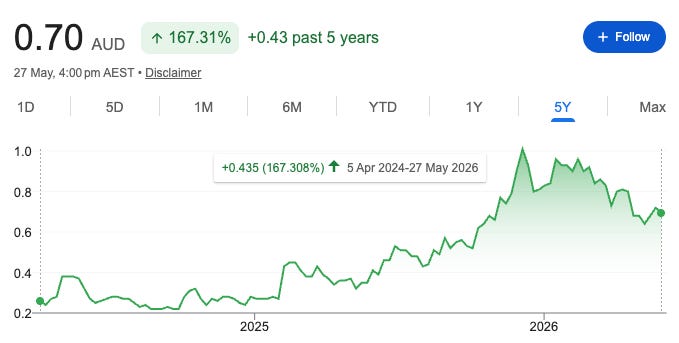
At A$0.695, BlinkLab carries a market capitalisation of approximately A$106M and an enterprise value of approximately A$83.6M, with around A$22.8M in cash — sufficient, on our estimates, to fund the key near-term catalysts.
On a scenario basis:
Pre-submission re-rating (Q4 2026 filing on schedule): ~A$1.20, +73%
12-month target (Q1 2027 clearance, US launch begins, Morocco and Dx2 support the platform): A$1.80, +159%
Bull case (clearance plus reimbursement, Dx2 momentum, Morocco commercialisation): A$2.50–3.00+
In our view, the market is still pricing BlinkLab as a typical pre-revenue developer, while the underlying asset is increasingly behaving like a strategic platform with a near-dated, well-defined catalyst path.
The bottom line
BlinkLab is a high-risk, high-upside opportunity.
The setup is rare: reported clinical data above the stated FDA benchmark, a binary catalyst inside the 12-month horizon, government-backed deployment validation, a hardware-light commercial model, and genuine platform optionality across ADHD, Europe and beyond.
The next 12 months are dense with catalysts — Dx2 results, the Morocco rollout, CE/MDR submissions, pivotal completion, and the FDA decision itself. Positive execution across even some of these milestones could compress the market’s discount well before clearance is formally achieved.
BlinkLab sits at the intersection of AI diagnostics, digital health, child neurodevelopment and health-system cost containment. In our view, that combination makes BB1 one of the more compelling digital-health opportunities on the ASX over the next 12 months.
Cashu Research rates BlinkLab a Speculative Buy with a 12-month price target of A$1.80 (159% upside). Risk: High.
Disclaimer: We provide only general financial product advice. General advice does not relate specifically to you and is prepared without taking into account any of your objectives, financial situation or needs. Before acting on it, consider the appropriateness of the advice having regard to your own objectives, financial situation and needs, and consider seeking advice from relevant legal, taxation, superannuation, financial and/or other advisors. The general advice relates to securities listed on an exchange (usually the ASX); you should consider any information published by the listed company (including prospectuses, ASX announcements and investor updates) before investing. Whilst Cashu Research has taken reasonable care, there is no guarantee by Cashu Research or its AFSL provider, ASG, that the information is accurate or up to date. Cashu Research or Cashu Group may receive fees for research or corporate communication services from companies mentioned. Cashu Research, its directors, employees or associates may hold or trade securities in these companies and may change such holdings without notice. The general advice in this report is provided by Cashu Research, part of Cashu Technology Pty Ltd, an authorised representative (AR #001318029) of Adviser Solutions Group Pty Ltd (ABN 88 601 875 521) (AFSL 485946) (ASG).