

Not investment advice. Disseminated on behalf of Strathmore Plus Uranium Corp.
(TSX-V: SUU | OTCQB: SUUFF | FSE: TO3)
When the same management team keeps showing up across multiple uranium success stories, it stops being coincidence and starts being a track record worth paying attention to.
Dev Randhawa, the CEO of Strathmore Plus Uranium (🇨🇦SUU / 🇺🇸SUUFF), is the same person who founded Strathmore Minerals, Fission Energy, and Fission Uranium. Strathmore Minerals was sold to Denison Mining for $85 million. Fission Uranium spun out and grew to a market cap above $630 million. Fission Energy was spun into what became a $112 million company. That’s a history of building shareholder value in uranium that goes back to 1996.
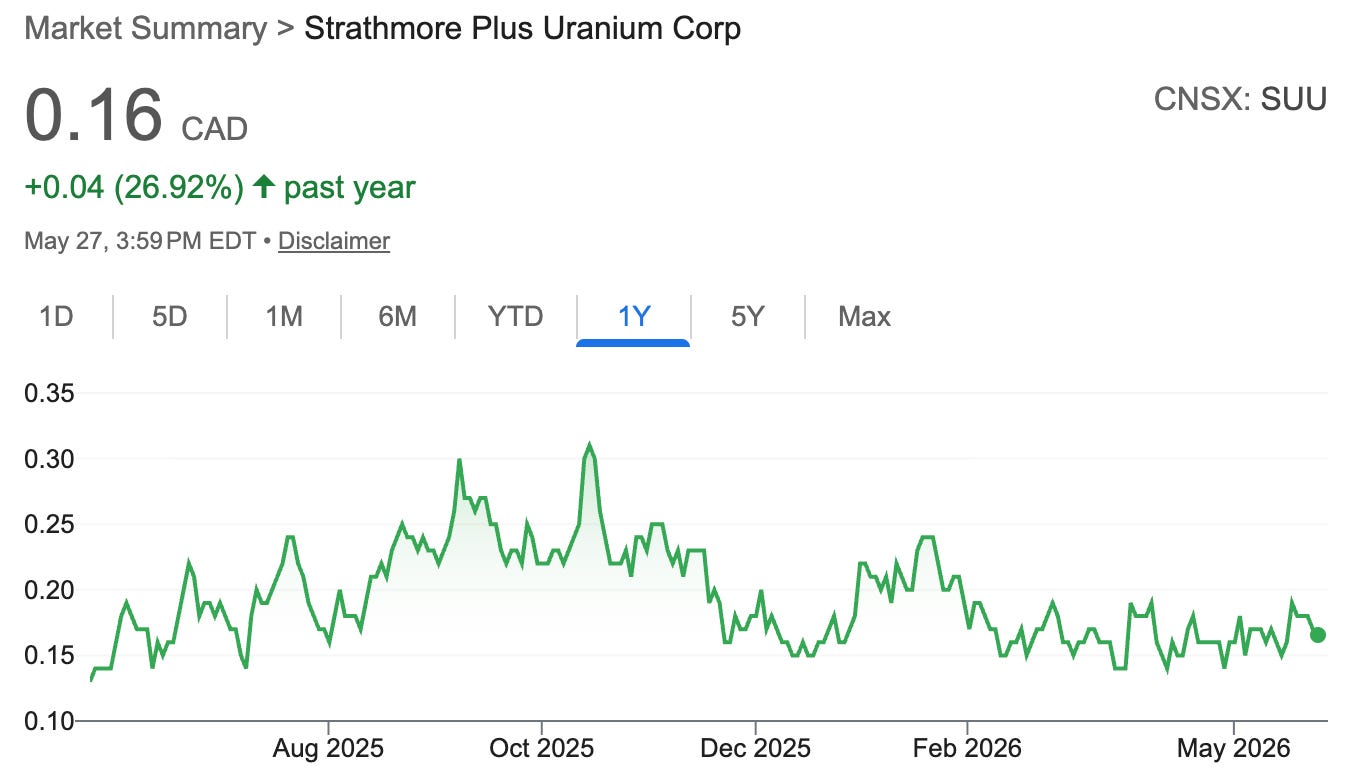
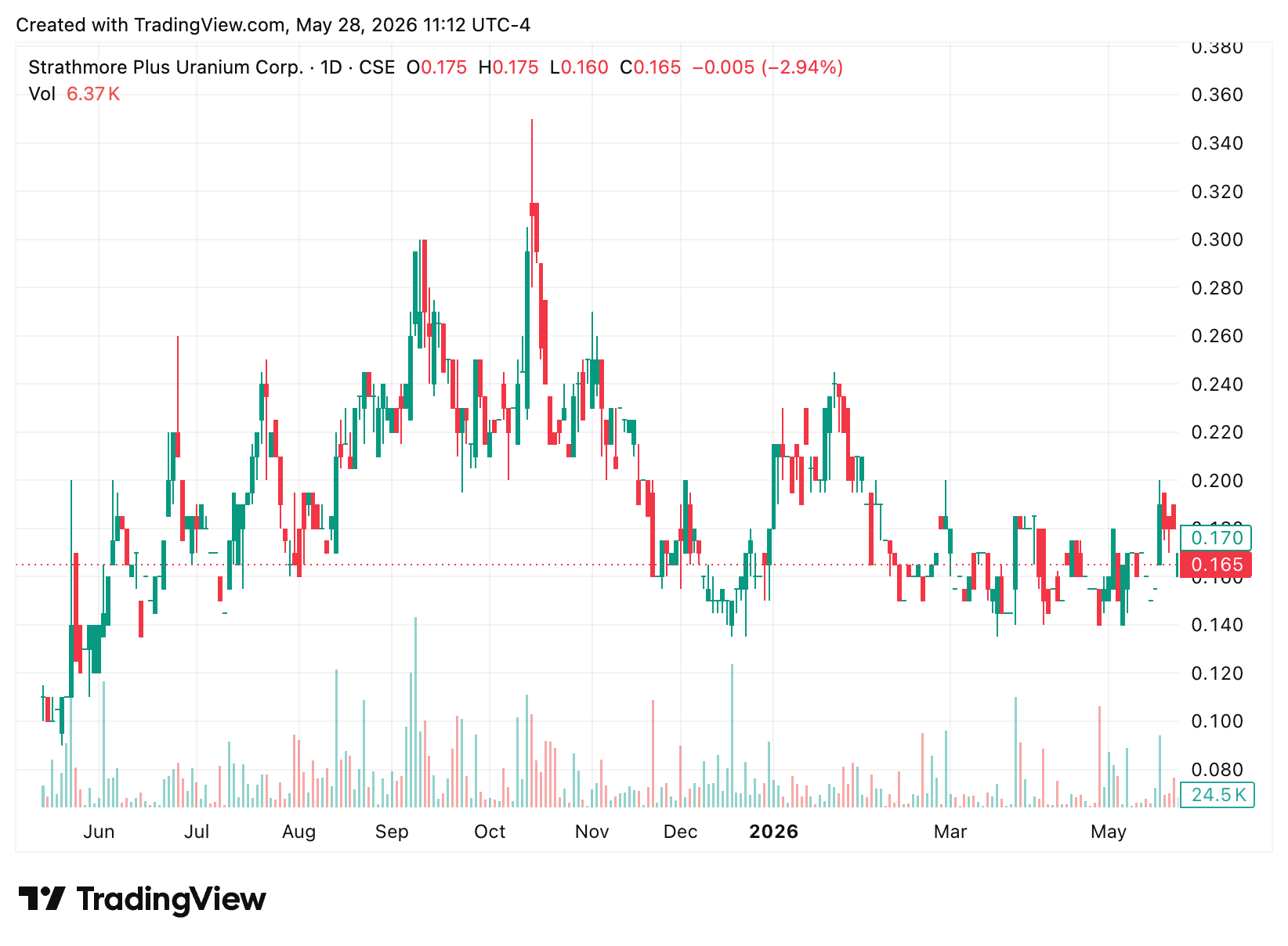
Now Randhawa and his team are running the smallest, earliest-stage vehicle in their portfolio. Strathmore Plus has a market cap of roughly C$9.4 million. And in early May 2026, they reported an 81% mineralization hit rate from their latest drill program in Wyoming.
That kind of consistency in the drill core, from a team with this track record, at this price point, is exactly the setup that experienced junior mining investors look for.
Why Wyoming, and why now
Wyoming is historically the second-largest uranium-producing state in the U.S., with over 250 million pounds mined across 70-plus years of operations. In 2018, Wyoming produced 78% of all U.S. uranium. The state is mine-friendly, has clear permitting processes, established infrastructure, and drilling costs that are significantly cheaper than the Athabasca Basin in Canada.
More importantly, Wyoming’s geology is known for hosting uranium deposits suitable for in-situ recovery mining. ISR is the lowest-cost method for producing uranium. Instead of building an open pit or underground mine, a solution is pumped through the ore body, dissolving the uranium, and the enriched fluid is recovered at the surface. It’s cheaper to build, cheaper to operate, and easier to permit.
Every one of Strathmore’s projects in Wyoming sits in geology that is prospective for ISR. At a time when the United States is scrambling to secure domestic uranium supply, a potential ISR project in a mining-friendly state is exactly what the policy environment is calling for.
Agate: 294 holes drilled, and the footprint keeps growing
The flagship is the Agate Project, a potential ISR uranium target in Wyoming’s Shirley Basin district. The Shirley Basin has historically produced over 52 million pounds of uranium, and Agate sits directly adjacent to properties held by Cameco and Uranium Energy Corp. UR-Energy’s nearby satellite ISR mine began producing as of April 2026, just 5.3 miles east of Agate.
Strathmore has now completed 294 drill holes at Agate across the 2023 to 2026 programs. In the Spring 2026 program alone, the company drilled 48 holes and hit mineralization in 39 of them, an 81% hit rate. Across the full history of drilling at Agate, 95% of the company’s holes have intersected mineralization. That kind of consistency tells you the system is real and laterally extensive.
The latest results confirmed a new Middle Sand mineralized trend extending over 2,500 feet, open in both directions. The existing Lower Sand trend was extended an additional 1,000 feet westward, bringing its total length to nearly 6,000 feet. Standout intercepts included 16.0 feet at 0.071% eU3O8 and 14.5 feet at 0.063% eU3O8 in the Middle Sand, and 4.0 feet at 0.102% eU3O8 in the Lower Sand.
The Middle Sand discovery is particularly important because the Middle Sand hosted most of the historically mined uranium in the Shirley Basin. Finding it at Agate expands the mineralized footprint and adds a second prospective horizon on top of the Lower Sand system that was already being delineated.
Mineralization at Agate is shallow, from 20 to 150 feet deep, and much of it sits below the water table, which is exactly what you need for ISR to work. The company is now advancing permitting with a Plan of Operation submission to the Bureau of Land Management and the Wyoming Department of Environmental Quality.
Beaver Rim: the second shot on goal in the Gas Hills
Beyond Agate, Strathmore holds the Beaver Rim project in Wyoming’s Gas Hills uranium district. Beaver Rim is 5,475 acres across 265 claims, positioned just south of Cameco’s Gas Hills project, which holds over 13 million pounds of indicated resources and 6 million pounds inferred.
In 2024, Strathmore drilled at Beaver Rim and hit mineralization with stacked roll fronts, validating the company’s geologic model. The team intercepted 0.042% eU3O8 over 7.5 feet at depth. The 2026 plan calls for 6,000 to 10,000 additional feet of drilling across 5 to 10 holes to expand on those results.
Several geologists have opined that Beaver Rim could mirror the grades and deposit sizes found in the Gas Hills. It’s early, but the geology is encouraging and the address is strong.
A $200,000 research partnership with the University of Wyoming
The University of Wyoming funded $200,000 in research to help Strathmore better locate drilling targets and uncover higher-grade mineralization at both Agate and Beaver Rim. The study focuses on near-surface geophysics to detect and image uranium roll fronts, with the goal of pinpointing drilling targets and potentially monitoring roll front movement during future ISR mining.
Academic validation of the geological model, funded by the university itself, adds another layer of credibility to the exploration thesis.
~55 million shares outstanding at a C$9.4 million market cap
Strathmore’s share structure is tight. Approximately 55.4 million shares outstanding, roughly 68.7 million fully diluted. At a market cap of around C$9.4 million, the market is pricing this company as if nothing has happened at Agate.
Meanwhile, the company has drilled nearly 300 holes, hit mineralization in the vast majority of them, discovered a new mineralized trend, is advancing permitting, and has a management team that has collectively created hundreds of millions of dollars in uranium value over three decades.
The bottom line
Strathmore Plus Uranium (🇨🇦SUU / 🇺🇸SUUFF) is a Wyoming-focused uranium explorer led by the same team behind Strathmore Minerals, Fission Energy, and Fission Uranium, a group that has been building shareholder value in uranium since 1996.
Their flagship Agate project has delivered an 81% mineralization hit rate in the latest drill program, with a new Middle Sand trend confirmed over 2,500 feet and the Lower Sand trend now approaching 6,000 feet. Mineralization is shallow, below the water table, and prospective for in-situ recovery. UR-Energy just started producing from an ISR mine 5.3 miles east of the property. Beaver Rim adds a second target in a proven district. And the whole company trades at roughly C$9.4 million.
The nuclear renaissance is accelerating. America needs domestic uranium. And a team with a 30-year track record of uranium value creation is drilling in the right state, in the right districts, at exactly the right time.
The ticker is SUU on the TSX Venture, or SUUFF on the US OTC.
Disclaimer: Disseminated on behalf of Strathmore Plus Uranium Corp. This newsletter is for informational purposes only and is not investment advice. It is part of a paid marketing campaign. Cashu Group was compensated by Strathmore Plus Uranium Corp. for the creation and distribution of this content. Investing in early-stage exploration companies is speculative and involves significant risk, including the risk of loss of capital. Any reference to ISR mining is conceptual only as no work to support any mining method has yet been done. All drill results, project details, share counts, and financial figures referenced come from the company’s public disclosures. Always do your own due diligence and consult a licensed financial professional before making investment decisions.